The last thing I ever said to my sister

On the spectrum of regrets the other bereaved people have, it certainly could be worse, but that does little to comfort me as I ruminate.

The last time I messaged her was May 6. Two weeks before she died. To be honest, that exchange also barely counts. The real last time was nearly a month before that. I cannot express to you how upset this truth makes me as I write it now in black and white on my screen.

It wasn’t uncommon for there to be weeks between messages. That hasn’t comforted me at all. In fact, it’s compounded the guilt. The time stamps are evidence of all the opportunities I didn’t take. The wrong choices I made, based on assumptions about a future that will never exist.

The last thing she heard from me, though, was a few days after our last text exchange. When she finally got around to opening this silly card I sent her, using an online service.
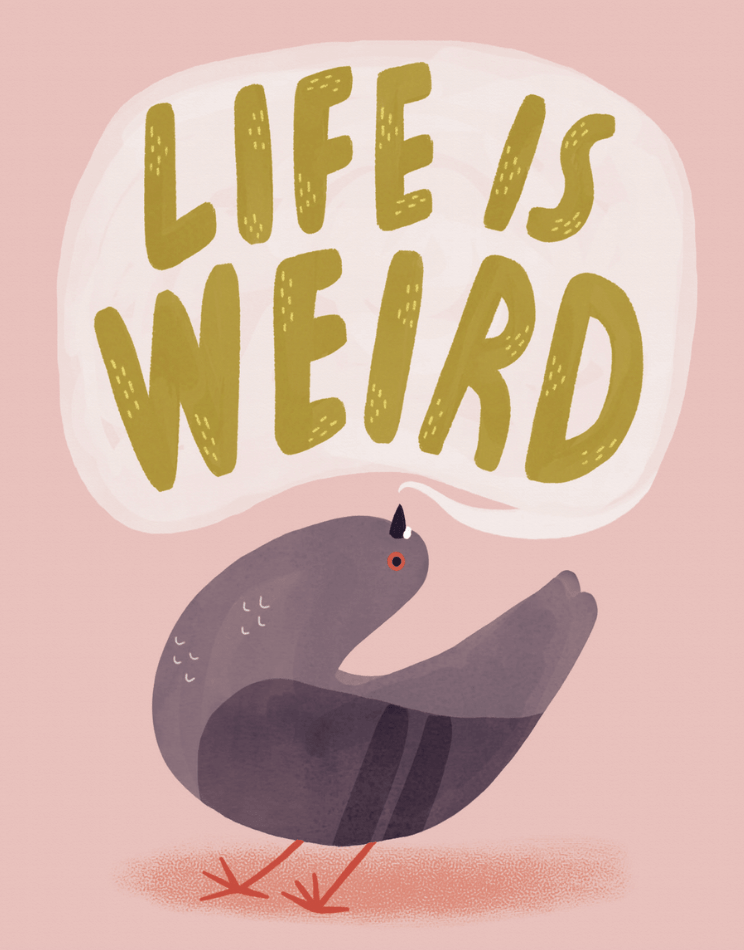
Inside was a short message:

Seeester,

I didn’t want to only have your address for the purpose of my background check, so I decided to also send you this ridiculous card.

LIFE IS WEIRD, BUT SO ARE WE. I hope you’re having a good day!

❤ Sarah

I have this card, now. It was open on the counter when I got to her home after traveling nearly 5,000 miles home. She never told me she had opened it, but I was told she had been very excited about it when it came. I hope that’s true. I wish I had written so much more in that stupid card. Is a heart emoji the same as telling someone you love them? Was a seven-word wish for a good day enough to tell her I thought about her often and wished her happiness?

The double gut punch of this all is that on May 19, the eve of my life irreparably breaking, I felt very, very content. A very important coworker and mentor was leaving, and I had written him a short letter thanking him and specifically explaining how he had impacted me. I was on good terms with a lot of people in the place I lived and worked, the place I would leave in a few short months. I distinctly remember thinking how wonderful it was to have no regrets about not saying something to someone, how pleased I was to have earnestly and generously verbalized all the things I would normally have just quietly thought before people left.

I had no idea that less than 12 hours later, I would be confronted with the unavoidable truth that I had not been as demonstrative with my sister. There had never appeared to be some transition that triggered a need to do so, I guess. As I sit here now, I think of all the hypothetical milestones I would have poured my heart out to her⁠—a promotion, her engagement to her wonderful partner, their wedding, them buying a house. I bought into the fallacy of there being a next time, and I robbed my sister of getting to know what I thought of her, truly.

So I’ll write it now, 84 days too late.

Sister, I spoke of you often. I still try to, but the weight of what I’m trying to say right now comes from you knowing that before you were gone, I did. In a sea of people who all do the same job as me, it was refreshing to brag about you being a culinary school-trained chef. People always thought it was cool. I’m proud of you for challenging path you took and the way you excelled in every kitchen you entered. People respected you, your work ethic, and your abilities. (For the record, I also always mentioned your insane black cat, your partner, the town where you lived, your love of peanut butter cups.)

Home would never quite be home without you there. It’s why I always coordinated my trips home with you. We were a set, a pair, and I needed that precious time to overlap with you as much as possible. As I write this now, I have to grapple with the fact that home may never quite be home ever again. Thank you for all these years of bending your holiday schedule around my travel.

For our whole lives, I’ve always considered you the pretty one, and it flattered me that you liked my style. I cherished all our sister shopping dates and when you would come to me to ask for fashion advice or a second set of eyes on an outfit⁠, especially in more recent times when that required you to message me. I would trade a whole hell of a lot for one more afternoon in the mall with you.

I am so happy you found love. I think one of the reasons I didn’t feel like we needed to talk as frequently was because I knew without any shadow of a doubt you had all the love, support, and affection you would need in your home, with your partner. You and he took care of each other in an effortlessly complementary way.

I took for granted that mom would tell me tidbits about your life, and so the time stretched long sometimes. I’m sorry. I wish I could have heard more of what I have in the past 84 days from you instead of through your friends. Your friends are lovely, by the way. I wish I could have met them with you at your favorite restaurant as a group, instead of somberly under the spectre of your loss and the vacuum you’ve left behind.

I’m proud of you. You found a way all your own and built a happy life. I wish you could have had another 60 years of time, because based on what I’ve learned since your death, you created positive ripples around you wherever you went. You left people’s lives changed for the better. I hope you knew you were a shining light for people. Somehow, I don’t think you did.

I love you.

How long should you take off work to grieve?

If there’s an answer, I don’t fully know it. The sad truth in my experience is you take what you can and then learn to work alongside the grief.

This feels like a very challenging trick question, doesn’t it? A lot is captured in the word should. The should that meant what was best for me was different from the should of the judgment of my supervisor when negotiating my return which was different from the should of other people’s opinions on the length of my acute mourning.

I can’t tell you how long you should take off, but I can tell you how long I did take off and how those choices affected me.

According to my employer’s policy, I was entitled to three days of bereavement leave per “bereavement incident.” I traveled internationally to get home to my family, informing work I did not know when I would be back. I read the rest of the leave policy during the 24 hours before I could travel, and determined sick leave could be use for “mental incapacity.” I was certainly mentally incapacitated.

I had no concept of how long I would be gone. I made some laughable verbal commitment to some friends that I would still like to go on a trip we had planned for June 1-4. I packed haphazardly as though I might be away a week or so.

After somehow surviving the first week⁠—getting through travel, making cremation arrangements, holding the private viewing, and picking up her ashes⁠—I felt pressured to tell my supervisor when I would return. We settled on June 2, a little under two weeks since I had left. I hadn’t accounted for the stress and physical impacts of grieving, though, and as it got closer to my flight date, I fell sick. The kind of head, ear, nose, and throat sick that would not have been fun to soldier through for major international travel. I pushed my departure back a week, but compromised by teleworking.

In retrospect, I would have been much better off if I had taken three full weeks to grieve and have no responsibilities. That third week would have been more restful (for my recovery from illness, especially) if I hadn’t been working. Nothing that I did in that week was particularly important.

I returned to work three weeks after I left.

Well, more accurately stated, my physical self resumed going to work three weeks later. But the rest of me⁠—my mind, my attention, my emotions⁠—only began to return to work in mid-July. Even now, as I write this, I can confidently tell you that I am not fully present at work ever. Sometimes I get lost on mental tangents. Sometimes I have no motivation to do anything at all and do the New York Times crossword. Sometimes I diligently work on drafting a document while silently crying and my boss comes in to talk to me, looks uncomfortable, and backs out as I say, “No come back. What do you need? Sometimes this just happens now.”

Some people have expressed to me that I was away too long. That they can’t understand why I haven’t “bounced back,” as though losing my sister was a minor inconvenience and not a life-shattering change to my reality that happened without my consent. Others have said they can’t imagine coming back as soon as I did, usually couched in a comment about how strong I am, which makes me cringe. If I were strong, I would have fought to stay with my family longer. I let the friction of other people’s expectations push me to return before I was ready.

So the only advice I’ll give you, if you have come here asking the title’s question, is this: please take as long as you can, as long as you need. It is a big assumption I am making that these are both the same, because many people cannot afford the length of time they need. Take it however you can. In half days off whenever it’s too much. In not-even-a-lie sick days when you are sick in your soul and not your physical body. Grief is exhausting and heavy. You’re building new muscles, but instead of a chiseled physique, you’re building the strength to carry yourself forward, mind, body, and soul. You’ve earned that rest.

Candid shots and unexpected Live Photos

They say a picture is worth a thousand words, but what’s the value of two hundred short video clips?

Her celebration of life is very soon, and so I had to go wading through photos to help find some to print. I knew it would be hard, but I didn’t expect to lose it completely. To be perfectly frank, I had a sobbing meltdown. Not because of the “nice” ones that made the social media cut, though.

Because of the outtakes in selfies with her partner where you can see these pure, loving glances between the two of them.

Because of the photos that show the way my sister’s face wrinkled up when she genuinely laughed.

Because of the fifteen photos in a row with her tongue out and her eyes wide with amusement.

Because of the unexpected two hundred 1-to-3 second clips her old iPhone captured when Live Photo was turned on, some of which contained her voice.

Because of the articles of clothing in the photos, some now hanging in my closet.

Because of the number of photos she took at times, trying to find one she liked, when she looked beautiful in every single one.

Because there will never be another photo with her in it.

It is not the job of the bereaved to make you less uncomfortable

Grief is pain. It is messy. It is unpredictable. And grief is countless times harder to bear if we’re asked to hide it away.

Allow me to start with a definition. The etymology of “bereave” lays bare the brutality of loss itself.

bereave (v.) Middle English bireven, from Old English bereafian “to deprive of, take away by violence, seize, rob.” Since mid-17c., mostly in reference to life, hope, loved ones, and other immaterial possessions.

Anyone who finds themselves in this place has suffered violence of the spirit. But we don’t treat all deaths as equally traumatic.

I have found myself angry during the times when I felt that the people around me were asking me to cower in the shadows to spare them the discomfort of my pain. The times when someone went out of their way to ask me about how I was coping, but they only wanted a chipper answer of no more than two sentences and disapprovingly reacted when that is not what I gave them. The times when people avoided me (sometimes physically dodging like cartoon characters) because they could not handle the possibility of being met with my grief.

To be clear, whenever possible, I have opted to not put myself in a public or social circumstances when I am at my worst. I understand the importance of retreat at times while I ride out the upwelling. However, I have to go to work, because I can’t take months of leave, paid or unpaid. I have to attend certain events, because my future self will regret not engaging with the people I still have and care about. I have to walk out into the sunlight because she loved the sun. I wish it were a societal norm to wear a physical mark of mourning, because I want the world to subtly know that however I seem, however I act, there is a wound under the surface that hurts all the time.

And so I want to unequivocally state here, on this space on the internet I’ve carved, that it is not the job of the bereaved to make the rest of the world less uncomfortable. Grief is pain. It is messy. It is unpredictable. And grief is countless times harder to bear if we’re asked to hide it away. Grief is also the desire in one moment to not mention who we lost and in the next moment, a profound need to tell someone, anyone, about them. Telling stories of my sister still makes me cry, but if I can’t tell them, then no one knows her, and that’s worse.

The people who will sit through the discomfort of watching my eyes fill with tears as I try to finish a sentence before looking away to collect myself enough to speak, those are the people who have made each day more survivable.

I cannot worry about how you feel right now. You may feel as uncomfortable as you wish, and I apologize for that feeling I may cause. But if you’re up to it and willing to lean into the discomfort, that gift you give me is so much more valuable than you know.

[Poetry] This Pain

This pain is not like the others
Because this pain is mine

I sit with it
I feed it my regrets and rumination 
I wake up with it snuggled around my chest
It sits in the corner and watches my moments of joy

This pain knows me intimately 
and strikes when I’m at my most vulnerable
It reminds me every moment is fragile
And it makes me doubt my choices

It can reach my heart, my mind, my DNA itself 
Any place there are traces of you
It patiently bides its time
And whispers, “your sister is dead.”

Please forgive me when I cry,
It’s not you that brings the tears
It’s the pain⁠—it robs me of the ability to remember you in joy
For now, but not forever

I promise.